My algorithm from 2013,
rebuilt with the discipline of 2026
I wrote this lane departure warning (LDW) algorithm for my 2013 undergraduate thesis. Its only surviving copy was OpenCV 2.x C/C++ code printed in the PDF appendix. Thirteen years later, I restored that code, measured where its assumptions failed, and modernized one element at a time while retaining the evidence.
Restoration — the 2013 logic runs again
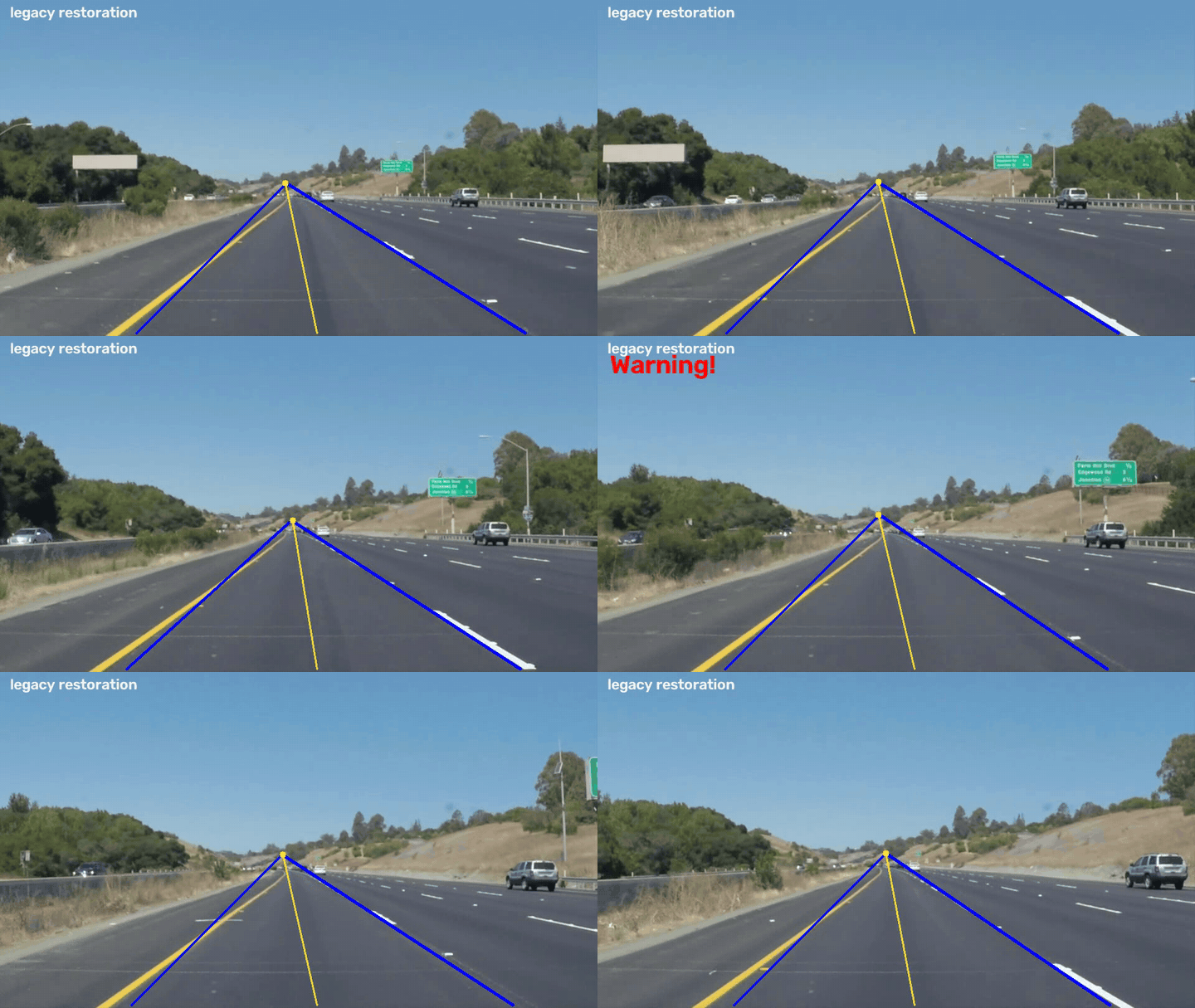
Road-video output from the restored legacy pipeline (public Udacity clip). Blue: detected lanes. Yellow: vanishing point and direction vector. Red: warning. The original logic is preserved: fixed ROI → Sobel/Canny → Hough → slope/distance filtering → vanishing-point estimation → fading-memory filter → warning after 2 consecutive frames.
The first failure — and its root cause
Running the literal port on a public video 960px wide detected both lanes in only 11 frames out of 221. The cause was the 150px candidate-distance gate in the 2013 code: a hidden resolution assumption tied to the original 640px source video.
Literal port (hidden assumption preserved)
Absolute 150px threshold → both lanes detected in the 960px video in 11/221 frames (5%)
Correction (assumption made explicit)
Scaling against the 640px reference width → same video: 221/221 frames (100%), with the original 640px behavior unchanged
This failure is documented in the repository README. The value of restoration lies in traceable root-cause analysis, beyond successful screenshots.
Four-panel comparison — the same frame, three generations of the algorithm

← Scroll horizontally. original → legacy restoration (2013 logic — Warning! false alarms flicker) → first modern (profile-based ROI + finite line-segment detection) → improved modern (control-state evaluation + gated ML).

A harder challenge clip with curves, shadows, and nearby traffic. While the legacy vanishing point fluctuates, the modern track exposes numerical detection confidence and state.
- First modern: promotes hidden constants into a profile schema (ROI policy, expected geometry, golden frames), making improvements measurable and comparable
- Improved modern: separates perception outputs from warning decisions, logging normal/caution states and risk scores for every frame
ML stays behind a gate — integration aware of domain shift
A lightweight ML lane-regression model is trained and runs on every frame, but its output is accepted only when it passes a segment-agreement gate against classical segment detection. It is accepted on most synthetic benchmark frames (the training domain), but on real road footage:
| Sample (real road) | Frames | ML run rate | ML acceptance rate | legacy warnings | improved states |
|---|---|---|---|---|---|
| udacity_solidWhiteRight | 221 | 100% | 0% | 0 | caution, normal |
| udacity_solidYellowLeft | 681 | 100% | 0% | 24 | caution, normal |
| udacity_challenge | 251 | 100% | 0% | 0 | caution, normal, unknown |
— the gate rejects every ML prediction. That is expected for a model trained only on synthetic data. The video overlay retains the evidence, for example ml rejected 0.36. The claim is that I built a system where ML outputs can replace classical detections only through measurable adapters and safeguards. The lightweight model is not presented as a production lane detector. Real models such as UFLD/ONNX can reuse the same adapter and evaluation pipeline.
Why this project
- Restoration discipline — recovering code from a PDF appendix while preserving the original design intent (source pinned with SHA256)
- Data schema thinking — a 20-video benchmark registry + profile JSON + golden-frame evaluation + SQLite evidence tables
- Control-engineering framing — separating perception from decisions, quantifying state and risk
- Restrained ML integration — presenting 0% acceptance as evidence, with an honest account of its limits
GitHub repository (code, tests, and documentation) ← Portfolio home